
Incarnation

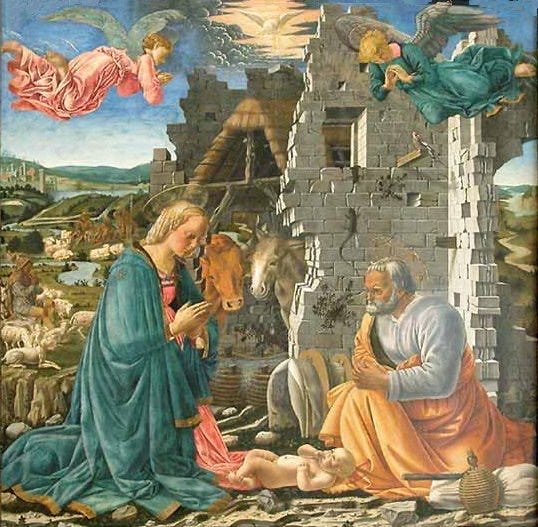
The birth of the Son of God to the woman Mary in Bethlehem is a great sign of God’s continued faith in His Creation. He pronounces it “good” in its genesis, but such events as the Deluge might lead one to wonder if that judgement remains true after the Fall; the Lord Himself condescending to dwell among men proves that the world is not beyond redemption, not without value. He does not co-operate with this world—no, its redemption consists precisely in His overcoming of the world, for which we are to be of good cheer. So subdued it may be transformed and remade: “Behold, I make all things new.”
God’s material Creation is echoed by men and women made in His image as they obey the first commandment, the genetic commandment. In the same manner the godly man or woman imitates the condescension of Christ—descending from the lofty realms of thought into the mundane world of matter, from abstract theologizing into ministry, from Pharisaism into worship in spirit and truth. How many there are that embody the condition Kierkegaard spoke against; pagans who live in the blissful illusion that they are Christians!
The subdual and transformation of the world, too, is reenacted by the believer in the subjective reevaluation of the world. “Subjectivity is truth,” writes S. K. The world is not merely a collection of facts, contra Wittgenstein. It is not merely a set of objective realities and things as they would be experienced by a generic, featureless observer who does not and cannot exist—no, it is precisely for the individual the relation between self and externality. By becoming transparently grounded in the Power that constituted it, the soul’s relation to its surroundings (that is, its world) is transformed, and he is made more than conqueror through Him that loved us.
And so too the miracle of the Incarnation is brought to life for the believer as he realizes himself as an existing individual. The Son of God is spirit become flesh, and so too the individual becomes their own flesh when they are no longer part of the crowd, for the crowd is untruth: no longer part of the age, nor the movement, nor the church, nor the mob, but solely a lone individual naked before God and grounded in that relationship. This is the true incarnation of the self—the indwelling of the Holy Spirit in the believer mirroring the blessed union of God and man witnessed in Judea so long ago.
“Verily, verily, I say unto you, He that believeth on me, the works that I do shall he do also; and greater works than these shall he do; because I go unto my Father.” The redeemed life is itself a microcosm of the Christ-mission. We have seen how the Christ-works are recreated in miniature by the redeemed; and shall we not say that the reformation of one’s own soul is a greater work than the miracles seen on the roads of Palestine? The winds and waves obey the voice of He who walks upon the water, yet the obedience of the mindless elements is no great feat compared to the winning over of an independent mind. This is the realization of, and thus in this sense the greatest part of, the redemptive work and atonement.
May we each this season remember the birth of Christ. God bless.
What I appreciate here is the way the birth of Christ is treated as a decisive affirmation of creation itself. If God chooses to enter the world as a human life, then ordinary human existence—time, matter, vulnerability, particularity—is not something to be bypassed or tolerated, but the very place where God’s presence is revealed. The Nativity quietly but radically restores human dignity by showing that being human is capable of bearing divine meaning. God's entrance into the world shows the value of the human being.