
God-for-us
Reposting for the archives an essay written as a guest post for Eurydice Lives.

Originally written as a guest post for Eurydice Lives. Link to the original below:

Our host on this blog and I have a shared religious background—and one curious (and often lambasted) dogma in that circle is the notion that God is a man. Not just the God-Man, Jesus, mind you (that would hardly be shocking), but His Father too. He presumably looks much as Michelangelo envisioned.
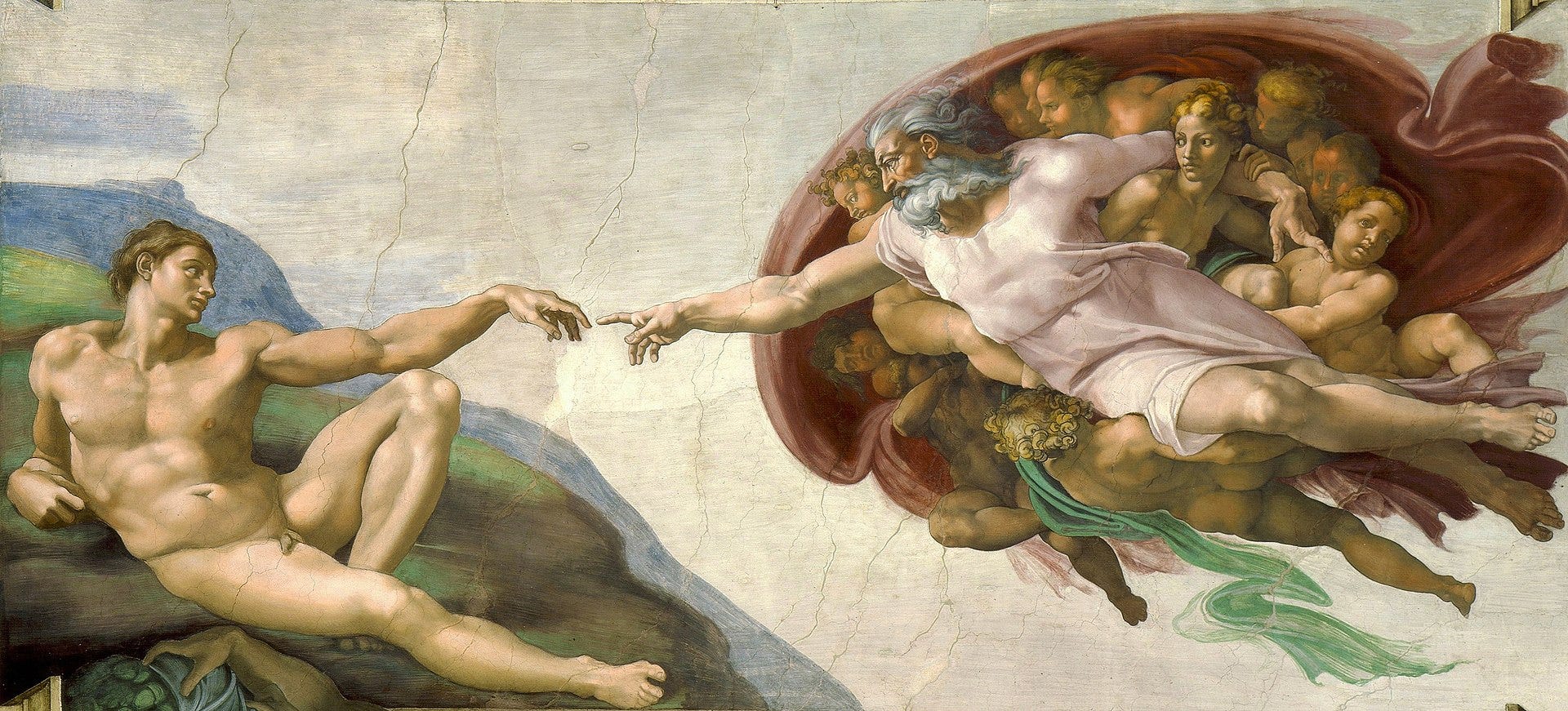
This is variously seen as blasphemous, heretical, ridiculous, or stupid in mainstream Christendom. It is clear why: God is all power, limitless potential, and infinite might; to say that such a being is bounded in some essential way, even if only in the extent of His limbs, seems contradictory, and even worse—corporeality suggests an etiology that is wholly incongruent with the notion of an Unmoved Mover. That Christ has a personal form is no difficulty, as He is the realization of the divine potential to descend and inhabit His own Creation, but to go beyond this is profoundly unorthodox.
But the theological and cosmological—in general, the speculative—implications of such a dogma are of no concern to us at present. We are disciples of the Dane, Kierkegaard, and so we instead reorient ourselves towards the existential attitude. We ask not only, “what is truth?” but also “what is the individual’s relation to the truth.” The introduction of the category of the individual changes everything; abstract concerns are as nothing compared to the realized concerns of the existing being—existential concerns. We deal not in the objective but in the subjective, and the subjective is higher than the objective in the sense that subjects outrank objects; we say not that “truth is subjective” as would a relativist or an idealist, but with Kierkegaard that “subjectivity is truth.” It is truth in the existential sense—we do not disregard objective facts (that would be foolish) but we understand that facts only matter as they exist in a context and this context is individual. Truth is more than fact; it lies in an individual’s right relation to a fact.
“If a tree falls in the forest and no one is around to hear it, does it make a sound?” is the juvenile example where the answer of speculative philosophy (an objective “yes!”) and the answer of existential philosophy (a subjective “no.”) diverge. Similarly we examine the old omnipotence paradox: “Can an omnipotent God create a boulder so heavy that even He cannot lift it?” A speculative examination would note the logical contradiction herein, how this suggests the ill-posedness of the statement, how its language might be of a kin with Chomsky’s “colorless green ideas sleep furiously,” syntactically but not semantically valid.
But lay all this aside. Ask, rather, “what is the individual’s relation to the god of the paradox.”
It seems, one way or another, that there are limits to the god, notions humanly conceivable and linguistically expressible that are nonetheless impossible whichever way the paradox falls. And so one understands that there exist lines the god cannot cross. The god is in this measure predictable and consistent.
(As an aside, consider the alternative. Recall that Kant proves the a priori validity of mathematics and logic for phenomena, the cosmos as subjected to the human intuitions of Space and Time, but does not do so for the ethereal noumena: existence-in-itself not existence-for-us. One supposes that in the realm of pure noumena there is no a priori reason why contradiction cannot be—the noumena represent the chaos of pure possibility until distilled into the perceptible phenomena. And such a noumenal god capable of both creating the unliftable rock and lifting it could not be a priori ruled out. Moving to the existential proper, we see that such a god would be a monster, Lovecraftian, horrible; the individual could never rely on such a being to be consistent in any manner. However, such a relation between individual and god could not be anyway, since the very relation ipso facto would be a relationship between the individual and the god as a cognizable phenomenon when we posited the god as noumenal.)
The bounded god is predictable. Consider this in the view of Calvinism, which posits a totally sovereign god with unlimited capacity to save. Some he elects and predestines for salvation, others for damnation, all through no merit of their own (for they have none)—thus, for the individual, salvation is effectively a matter of chance. One’s relationship to such a god is not that of a petitioner but that of a gambler all-in; filled with fearful anticipation, dread, and awe, but not the higher passions of love and faith. The unbounded god is unpredictable and thus unreliable.
And thus with the problem of evil. The unbounded god could abolish suffering and still accomplish his designs for his creatures without, and a benevolent unbounded god would do so. The continued existence of suffering demonstrates sufficiently that this god is not. The relation to the benevolent bounded god, however, acknowledges a a Leibnizian cosmos that is “the best of all possible worlds”—not the greatest world of which one could conceive, just as an unliftable rock is conceivable, but the greatest possible creation given the bounds of the god. One’s relation to an unbounded god given suffering can only be rage against the god’s malice; one’s relation to the bounded god instead one of acceptance, even submission. And this goes beyond the merely abstract into the most concrete existential dimensions; the praying man who becomes upset when his prayers go unanswered tacitly assumes for himself the unbounded god, that regardless of the god’s non-abolition of suffering in general the god-for-him had the power to do so but lacked only the will. On the other hand, the petitioner who accepts the existence of suffering will not be surprised when his own personal suffering is not abolished, despite his pleas; disappointed, surely, but he experiences no contradiction.
We are piece by piece arriving at the inexorable conclusion: only a certain type of god can engender the particular relationship with the individual which we call faith. What is faith? It is the highest of the human passions; it is frequently manifest between men and women in the form called love. The lover yearns for the other and places trust in them, and expects the same in return despite the absence of absolute assurance; faith is the same with the Divine. This is why genuine marital love is called faithfulness and fidelity.
The Azathothian god beyond contradiction cannot be trusted. The Calvinist god can similarly only appear to his devotees as capricious. A god who reveals himself publicly and proves to every human without a doubt his omnipotence and omniscience (the god the more naive brand of atheist often has in mind) cannot generate the passion of faith either, reducing himself to a mere fact or newspaper headline.
What does Paul say? “Indeed there are many ‘gods’ and many ‘lords,’ yet for us there is but one God, the Father, from whom all things came and for whom we live; and there is but one Lord, Jesus Christ, through whom all things came and through whom we live.”1 There it is! The for us! The Kierkegaardian subjective! Of all the many gods and many lords conceivable there can be but one in the passion of faith, and it is the one we call Abba, Father.
And this Father is bounded in the ways we have seen such that not every concept can be realized by Him; and, it seems, that when presented with the choice between a world with both suffering and faith and a world devoid of both He considered it a small price to pay for so great a prize.
And rightly so! For we understand by way of Martin Luther that faith transmutes the suffering.
This is a splendid privilege and hard to attain, a truly omnipotent power, a spiritual dominion in which there is nothing so good and nothing so evil but that it shall work together for good to me, if only I believe.2
How this passage must have inspired Kierkegaard in Lutheran Denmark as he considered the category of the individual! And so Søren writes:
This then is the formula which describes the condition of the self when despair is completely eradicated: by relating itself to its own self and by willing to be itself the self is grounded transparently in the Power which posited it.
In the passion of faith even the horrific—such as Abraham’s offering of Isaac—turns to good by faith, by virtue of the absurd.3
When we consider the god of faith, it seems that he must be a bounded god. And further, it does not seem ridiculous that such a god be within space and time rather than without. If one conceptualizes the god in the speculative sense as “the maximal entity in power and knowledge,” one is likely to arrive at an unbounded god à la Calvin; on the other hand, if one conceptualizes the god as “the entity maximally capable of exciting faith in man,” one is more likely to arrive at Joseph Smith’s. And so the American declares, “it is the first principle of the Gospel to know for a certainty the character of God and to know that we may converse with him as one man converses with another.”4 There is here the anticipation of the existential attitude, of being concerned with God-for-us rather than God-in-himself, that God is the God who intimately relates to His worshippers.
I am asked by our host whether my understanding of the world supports my faith. I find the question alien because it comes from the speculative attitude—do I consider that such-and-such facts are compatible with such-and-such priors? But through the existential lens, faith (in the sense of worldview, as it is used here) is identical with the world-for-me. The question becomes not of such-and-such facts but with such-and-such fact for me, or in other words, the subjective significance and import of the facts. In any case, as I explain at length elsewhere, for me the primary problem is epistemology—how one can know; the simple answer is, one cannot know, and so there are only a few approaches left, either nihilism or absurdism, and as with Kierkegaard I adopt that absurdity which is called faith.
1 Corinthians 8:5-6, NIV.
From Freedom of a Christian.
See Kierkegaard’s Fear and Trembling.
If God did not at least seem capricious to our human eyes, He could not be God, whose deeper will cannot be known to us save by the blessing of the spirit (1 Cor. 4:10); it is such a God that demands faith by necessity rather than intellectual sensibility.
To some this may seem as a gamble, but it is not so for us: for the elect know our own standing with God from deep within our spirit, even as some of the reprobate for a time are also bestowed evanescent grace for our sake. Faith is a gift, and it is one given to be tested and strengthened by trial, temptation and even lapse into sin.